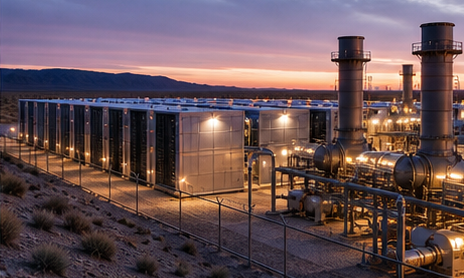
As of August 9, 2026, Beijing time, the New York Times reported that Amazon had confirmed its investment in a natural gas power plant to power its Texas AI data center, and said that the company had recently acquired relevant sites in Pecos County. The Verge followed up at 17:53 UTC on August 8, and its public summary also attributed Amazon investment and site information to the New York Times. The newspaper’s public page metadata marked the report date as August 8; as of press time, Amazon had not released a separate project announcement, and this confirmation is still an attributable report by The New York Times.
Application documents and private grid
A summary of the preliminary determination made public by the Texas Commission on Environmental Quality lists Pacifico GW LLC as the applicant for the GW Ranch Energy Center air permit, with permit numbers 181033, PSDTX1672 and GHGPSDTX255. The document locates the site along Highway 18 in Pecos County, Texas, about 17 miles north of Fort Stockton, with a postal address in the Fort Stockton, Texas 79735 area. The proposed facility is a natural-gas simple-cycle power plant with a nominal output of 5,000 MW, and the regulatory summary lists 35 gas turbines under that configuration.
Regulatory documents state that the plant will power an AI data center on the same site and is not allowed to sell power to or receive power from the local utility distribution system. Pacifico described the private-grid design as allowing customers to control the pace of construction, energy supply, cost stability and expansion, and argued that the project would not increase ERCOT grid load or consumer electricity prices. Those last two points are developer claims and have not been independently confirmed by the cited regulatory documents; the documents confirm the plant's purpose and the arrangement barring it from buying or selling electricity through the local distribution system.
Equipment plan and modeling assumptions
The Texas regulatory summary lists 35 simple-cycle gas turbines, including 21 Siemens SGT-800s and 14 large-frame combustion turbines. The applicant plans to use control technologies including dry low-NOx burners, selective catalytic reduction and oxidation catalysts. These details are part of the air-permit application; the documents do not describe the facilities as completed or producing operating data. The summary's descriptions of equipment, fuel and proposed controls are components of the application, not verification of operating results.
Permit modeling calculates routine operating emission rates by assuming that each turbine runs on natural gas for 8,760 hours per year. It calculates startup and shutdown emissions separately, assuming 52 startups and 52 shutdowns per turbine per year, each lasting no more than 60 minutes. These are regulatory modeling assumptions used to define proposed permit conditions, not operating records, a project schedule or a forecast of actual future emissions. The startup and shutdown counts therefore cannot be presented as an established annual operating plan.
Emissions caps and developer plans
The same preliminary-determination summary lists a proposed annual allowable-emissions cap of 33,204,964.44 tons of carbon-dioxide equivalent, covering carbon dioxide, methane, nitrous oxide and sulfur hexafluoride. The Verge headline described the project as potentially becoming one of the most polluting power plants in the United States; that conditional description is based on the permit cap, not actual emissions or an established national ranking. The proposed cap is the maximum under the permit framework. It cannot replace monitoring data after operations begin, and the existing documents provide no actual emissions records.
Pacifico's official project page says GW Ranch's air permit covers up to 7.65 GW of dispatchable generation. The company plans to add 1.8 GW of battery storage and up to 750 MW of AC solar power. The page schedules initial power delivery for the first quarter of 2027, says 1 GW is due online in 2028, and targets more than 5 GW by 2031. These are the developer's current plans; operating results cannot yet be checked. The company also describes the site as being in the Permian Basin of West Texas and cites access to natural gas, flat terrain and distance from what it calls environmentally sensitive areas as reasons for the location.
Capacity and undisclosed information
Project size is reported on two different bases: the Texas regulatory summary gives the proposed natural-gas plant a nominal output of 5,000 MW, while Pacifico's project page says the air permit covers up to 7.65 GW of generation. The figures come from different documents and cannot be added together or recast as the regulator simultaneously confirming one capacity measure. Media descriptions of a pollution ranking also remain conditional because the regulatory material supports a proposed permit cap, not an established ranking based on actual emissions.
Amazon's investment in and connection to the GW Ranch site can only be described as reporting attributed to The New York Times. Neither the developer's project page nor the Texas regulatory summary confirms Amazon's investment amount, acquisition price or data-center scale. Public material also provides no actual emissions, built capacity or operating results, so neither the proposed permit cap nor the developer's timetable can be presented as an accomplished operating fact. The project's financing status, numbers of buildings and chips, water use and actual construction status were not disclosed in these public materials.