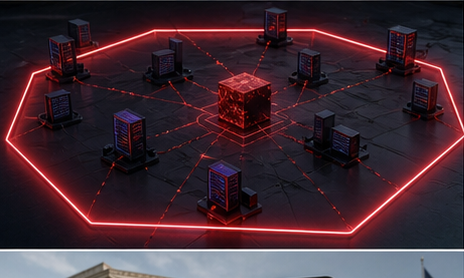
On October 9, 2026, Beijing time, Anthropic launched the Anthropic Cyber Mission on October 8, U.S. time, and launched two first batch arrangements at the same time: the Critical Infrastructure Defense Program for power grids, water supply, transportation, factories and government system operating technologies, and the OSS Scanner, which is provided free of charge to eligible open source projects. The former hands over the Claude model, resident engineers and threat research to existing security and equipment service providers; the latter uses an active application mechanism to regularly send vulnerability reports generated by the model to maintainers.
Key facilities plan to introduce 11 partners
There are 11 founding partners in the critical infrastructure program, including Accenture, Booz Allen, CrowdStrike, Deloitte, Dragos, Hitachi, Insane Cyber, Nozomi Networks, Palo Alto Networks, PwC and Rockwell Automation. Anthropic said that several partners are already using Claude to deal with vulnerabilities, but it is only working with a small group of providers in the first phase. The goal is to observe which methods are suitable for running industrial systems; the announcement did not write that this cooperation has covered all facilities or industries.
OSS Scanner does not automatically scan all public repositories. Anthropic requires core maintainers of key open source projects to submit pull requests to designated GitHub repositories according to the template. Qualifications generally refer to the standards of Google OSS-Fuzz's impact on infrastructure and user security, and are determined by the company on a case-by-case basis. The official page does not limit countries or regions, nor does it announce the complete list of the first batch of selected projects. Anthropic also said that this fast track is mainly for maintenance teams that have the ability to continuously handle large numbers of discoveries; projects with insufficient resources can still receive manual verification reports through its coordinated vulnerability disclosure process.
Open source scanning adopts an application system and direct model reporting
Selected projects will receive periodic scans for free, and Anthropic says the system used includes the strongest models such as Claude Mythos. Each report can include an independent reproducible program, an explanation of the vulnerability, a binary analysis that locates the version where the flaw was introduced when conditions permit, and candidate patches when available. The scan results will be directly handed over to the maintainer to verify, prioritize and decide whether to fix them; candidate patches do not mean that they can be deployed directly without testing. The announcement did not disclose scan frequency, processing caps or service capacity for individual projects, or whether different projects use the same configuration.
The speed arrangement also brings clear limits. The output of OSS Scanner is completely generated by the model, and Anthropic does not perform manual review or grading before sending; officials admit that the report may be invalid, the severity judgment is too high, or the project's own threat model is misunderstood. The public information flow of The Verge summarizes this release as a free open source project AI security scan, and mentions that the lack of manual review may increase the burden of false positives, which has no substantial conflict with the limitations of Anthropic's announcement. The maintainer thus gets technical clues to be verified rather than a list of confirmed vulnerabilities.
The number of candidates and sample verification need to be interpreted separately
Anthropic said that scans in the past six months have discovered more than 29,000 candidate vulnerabilities, but its team has only completed manual review and triage of about 6,000; after maintainers actively requested to receive all results, the company directly sent nearly 5,000 unverified reports. The above numbers are all from Anthropic's self-reports. There is no independent audit in this round, and candidate vulnerabilities cannot be directly counted as real vulnerabilities. The company cited insufficient manual processing capabilities as the reason for launching the fast track, while retaining the manually coordinated disclosure path for other projects.
The official also announced a set of early verification samples: expert penetration testers checked 97 high-risk or severe results in 48 projects, 85 of which met the standards of Anthropic's coordinated vulnerability disclosure process; of the remaining 12, 11 were determined to be real but were duplicates of known issues or other results of the same scan, and 1 was invalid. The wolfSSL maintainer also reported receiving 74 reports, 72 of which were valid, and 5 of which later became CVEs. These are sample-specific and participant responses and cannot be inferred as an overall accuracy rate for all items.
Operating technology boundaries and undisclosed matters
Anthropic expects that the true positive rate of OSS Scanner will be higher than 90% in the future, but this number is a company goal and is not a guarantee that it has passed external audits, nor can it be confused with the passing rate of the disclosure standards of the aforementioned 97 high-risk samples. On the operational technology side, where equipment is proprietary, downtime is limited and erroneous changes could impact the plant or public services, plans therefore advance with the operator's existing consulting, safety and equipment providers. Anthropic also acknowledges that critical infrastructure defense contains many problems that AI cannot solve, and patching still needs to be combined with on-site security requirements.
As of this round of verification, Anthropic has not disclosed OSS Scanner’s complete first batch of project lists, fixed scanning cycles, total processing capacity, data retention arrangements, exit mechanisms or regional scope; the critical infrastructure plan has not announced specific customers, number of resident engineers, contract amounts, model deployment methods, facility data processing arrangements and quantifiable risk reduction results. Expanding partners and industries in the coming months is only a company plan and there is no specific date yet. What can be confirmed at this stage is the plan structure, application method, founding partners, company self-report samples and clear manual verification boundaries.