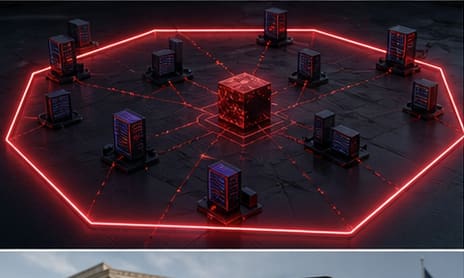
On November 5-6, 2026, Beijing time, security research institutions Check Point Research and Censys Advanced Research Collective successively disclosed a large number of publicly accessible ARTEX autonomous penetration testing framework consoles. TechCrunch subsequently published related metadata reports through authorized information streams. The two institutions adopted different measurement times, statistical units, and de-duplication methods, so the resulting figures cannot be combined into a single global total.
Two Institutions Disclose Large Number of Public ARTEX Consoles
ARTEX was originally designed for authorized security assessments and is an open-source penetration testing framework driven by large language models. According to Censys, its planning agents break down test targets into attack intents, work agents invoke security tools to execute tasks, the event loop continuously explores, makes decisions, and records results, while assets and test progress are respectively stored in graph structures. The project was released on July 26, and developers announced a transition to closed source on October 8 following reports of malicious use; although the original repository has been removed, archived, translated versions, and renamed branches remain in circulation.
Check Point Research stated that their measurement found 2,557 systems that had ever hosted or were currently hosting ARTEX panels, with 1,608 of these still online and accessible from the public internet at the time of the study. The team also identified 10 instances with misconfigurations exposing complete ARTEX databases, allowing researchers to view models selected by operators, tasks issued, prompt content, and agent execution records. These figures represent the observations of the institution at a specific point in time and under particular methods, not a global deployment total.
Framework Originally Designed for Authorization Testing Now Being Misused
Censys recorded 1,465 hosts exposing ARTEX consoles as of November 4th, with approximately 650 of them concentrated in two hosting segments with nearly identical configurations. The agency believes this concentrated deployment is more consistent with a unified template rather than hundreds of different operators; after removing these two segments, approximately 815 deployments with distinct appearances remain. Censys measures and processes centralized hosting by host, while Check Point simultaneously counts systems that have ever and currently host panels, making the two sets of results not directly summable.
Among the 1,465 hosts recorded by Censys, 155 simultaneously triggered at least one other threat detection, including other AI attack frameworks, reconnaissance platforms, tunneling tools, and command and control software. Researchers also observed 32 ARTEX hosts with open directories containing post-exploitation tools, loaders, implants, command history, or SSH materials; between November 3rd and 5th, 10 directories were closed while another 15 appeared. Coexistence and exposure are observational signals that cannot be used to conclude that all hosts are operated by criminals or have been compromised.
Check Point Observes 2,557 Systems and 10 Exposed Databases
Check Point's analysis of 10 exposed databases indicates that some operators only set initial targets and then primarily monitor progress, with agents independently completing reconnaissance, vulnerability discovery, and exploitation steps. An operation targeting cryptocurrency services set up 292 targets, generating 230 discoveries and 400,791 agent messages, with no new operator prompts after the initial targets. This operation processed 167.5 million tokens, identified remote code execution paths and exposed databases, but the research records show the operator's wallet balance was zero, with some agents misinterpreting API success returns as funds already transferred out.
Check Point also recorded a supply chain case: agents, while investigating infrastructure related to specific cryptocurrency wallets, discovered an unauthenticated API exposing AWS S3 credentials, gaining write permissions to buckets storing iOS applications and landing pages, then modifying content and validating attack paths. The research states that the original files were later restored, with no evidence that operators profited from the incident. The source did not specify the number of affected users or complete follow-up measures, therefore this operation cannot be documented as having caused economic losses, long-term control, or successful profit generation.
Censys record host count versus deployment deduplication differences
The numerical discrepancies between the two studies also include Check Point's own summary versus full text expression: the summary states over 1,800 publicly exposed instances, while the detailed content lists 1,608 online public instances, plus 2,557 historical or currently hosting systems. Censys' 1,465 hosts were measured as of November 4th, and further separated two identical configuration hosting blocks from different appearance deployments in the estimation. The differences in dates, host and instance units, historical record scope, and duplicate hosting treatment make it insufficient to determine which number can represent the entire ARTEX infrastructure.
Public measurements still cannot provide the exact deployment count of ARTEX globally, nor can they confirm the identity and intent of each operator. Censys explicitly stated that some publicly controlled consoles may be operated by authorized testers; Check Point's conclusion regarding low human intervention comes from its analysis of 10 exposed databases, which cannot be extrapolated to all instances. The server hosting locations listed by Check Point do not equal the victims' locations. TechCrunch contributed only titles, short summaries, times, and links from the public information stream in this round; its publishers' full text was not obtained or used in this process.