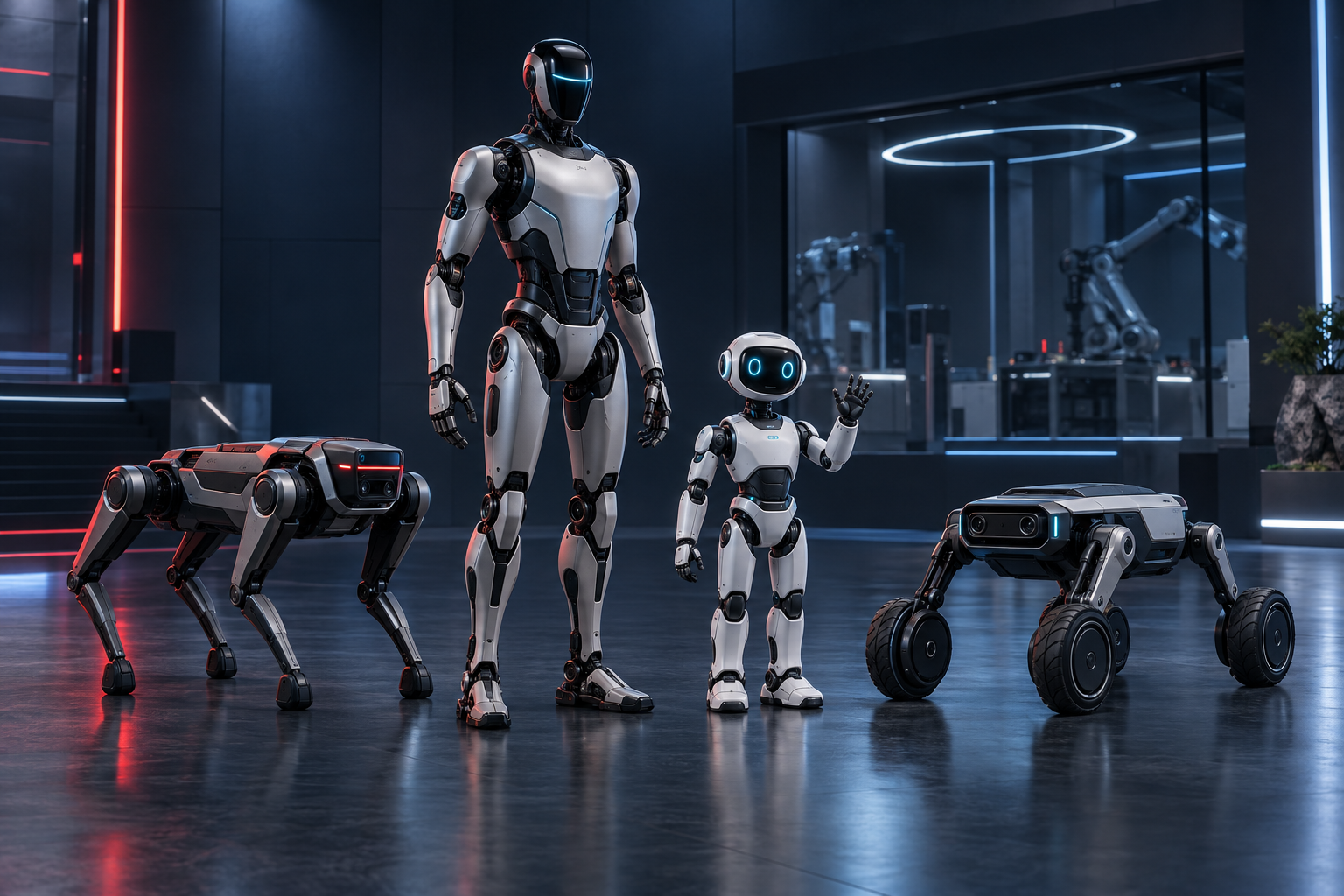
On September 20, 2026, Beijing time, Faraday Future released five models and nine configurations of embodied intelligent robots, and announced four sets of industry plans for basic education, scientific research, security and inspection. The company said that the new products have entered the sales and delivery process, and the official store also lists the products and prices of All-New Futurist and Master Mini during collection. This update also provides hardware pricing, skill packages and target scenarios. However, the battery life, computing power, load and obstacle performance all come from company announcements, and the existing public information does not provide independent laboratory testing or customer acceptance results.
Release time and flagship humanoid machine
The release event started at 17:00 Pacific Time on September 19th, which is 0:00 UTC on September 20th. The company subsequently issued an announcement at 0:57am. The release was based in Los Angeles and provided a video of the online event, but did not specify where all new products would be manufactured. The nine configurations cover both humanoid and quadrupedal bodies, and belong to three series: Futurist, Master and Aegis. The specific models are FF All-New Futurist, FF Master Mini, FX Aegis Hyper, FX Aegis Mega and FX Aegis Classic Ultra-W. The five models and nine configurations here only refer to this new product and cannot be confused with the company's entire product portfolio after release.
All-New Futurist is positioned by the company as a full-size professional humanoid robot. The standard version has 51 active degrees of freedom, which can be increased to 71 after installing high-end dexterous hands; the 1152-watt-hour dual battery can run for about 8 hours under what the company calls standard working conditions, and supports independent charging. The Ultra version uses NVIDIA Jetson Thor, and the company's nominal computing power is 700 TOPS; the announcement also included visual language action models, world models and task planning in its software portfolio. The Standard and Ultra versions are priced at US$89,900 and US$129,900 respectively, and the accompanying skill packages have nominal values of US$10,000 and US$15,000 respectively.
Educational humanoid machine and industrial quadruped
The Master Mini series includes three configurations: Mini, Pro and Ultra. The body is about 95 cm tall and weighs about 19.5 kg. The three levels of computing power given by the company are 48, 117 and 200 TOPS respectively. It also said that the product has open motion, perception and application interfaces, and its target uses include programming education, secondary development, entertainment performances and robot football. The three versions form a price gradient from basic teaching to higher computing power development. The prices are US$9,990, US$12,990, and US$17,990. The nominal values of the accompanying skill packages are US$1,000, US$1,500, and US$2,000.
Four-legged products cover lightweight, medium and large solutions. Aegis Hyper is designed for extreme environments, heavy loads and high-risk operations. It can be equipped with thermal imaging, gas detection, three-dimensional scanning and communication relay equipment according to the company's plan. The starting price is US$137,900 and comes with a skill package with a nominal value of US$15,000. Aegis Mega is available in two configurations. The company has a nominal maximum load of 50 kilograms. It can continuously pass 25 cm steps and cross single-level obstacles of up to 80 cm. The hot-swappable dual batteries have a nominal battery life of no less than 5 hours under no load. The starting price is US$74,990, and the skill package has a nominal value of US$8,000.
Product portfolio and four sets of industry solutions
Aegis Classic Ultra-W adopts a wheel-foot structure and has a body of about 22 kilograms. The company positions it for security, companionship, simulation training, multi-machine collaboration and professional load expansion. It also says that it can handle both wheeled movement and foot-based obstacle crossing. The price is US$12,990, including a skill package with a nominal value of US$3,000. The company also announced that after the release, the complete product system will cover three forms: humanoid, quadruped and wheel-arm, including five series: Futurist, Master, Aegis, Navi and Faber, with a total of 11 models and 24 products; the last two numbers are not the number of new products released this time.
Among the four sets of industry solutions, the basic education solution takes Master Mini as the core, with course tools including Blockly, Python and ROS, and integrates robots, development kits, courses, competitions and equipment management into the same package. The scientific research plan lists a unified software development toolkit, ROS interface, simulation, digital twin, data collection, model training and skills management. The security solution is for communities, campuses, warehousing and key facilities, and the inspection solution is for energy, power, manufacturing, mines, tunnels and large facilities. Thermal imaging, gas detection and three-dimensional scanning equipment can be combined according to the announcement; these are the configurations and target scenarios announced by the company.
Sales Entry and Evidence Borders
The company divides product sales into three categories: standard ontology, ontology plus skill package, and ontology plus solutions, and lists six types of channels, including corporate direct sales, e-commerce, and community, as well as the RoboShare leasing portal. The official announcement stated that all new products have started the sales and delivery process, but public stores can only directly verify some products and prices during collection, and cannot confirm the inventory, arrival time or actual transaction volume of the nine configurations. IT House’s public information flow on September 20 confirmed the release range of five models, nine configurations and four solutions, without providing independent measurement of product performance.
The existing information does not disclose the first batch of delivery quantities, customer lists, manufacturing locations, quality assurance conditions and actual deployment scale of each configuration, nor does it have independent data to verify the multi-modal data closed loop and industry investment return proposed by the company. There is also no public comparison of the performance of the product under different loads, temperatures, terrains and continuous tasks. The battery life of about 8 hours is limited to what the company calls standard operating conditions. The Aegis Mega's figure of at least 5 hours is limited to the no-load state and cannot be extrapolated to all mission environments. The store page can confirm the product entry and price at the time of collection, but it cannot prove the spot supply, delivery progress or customer use effect.