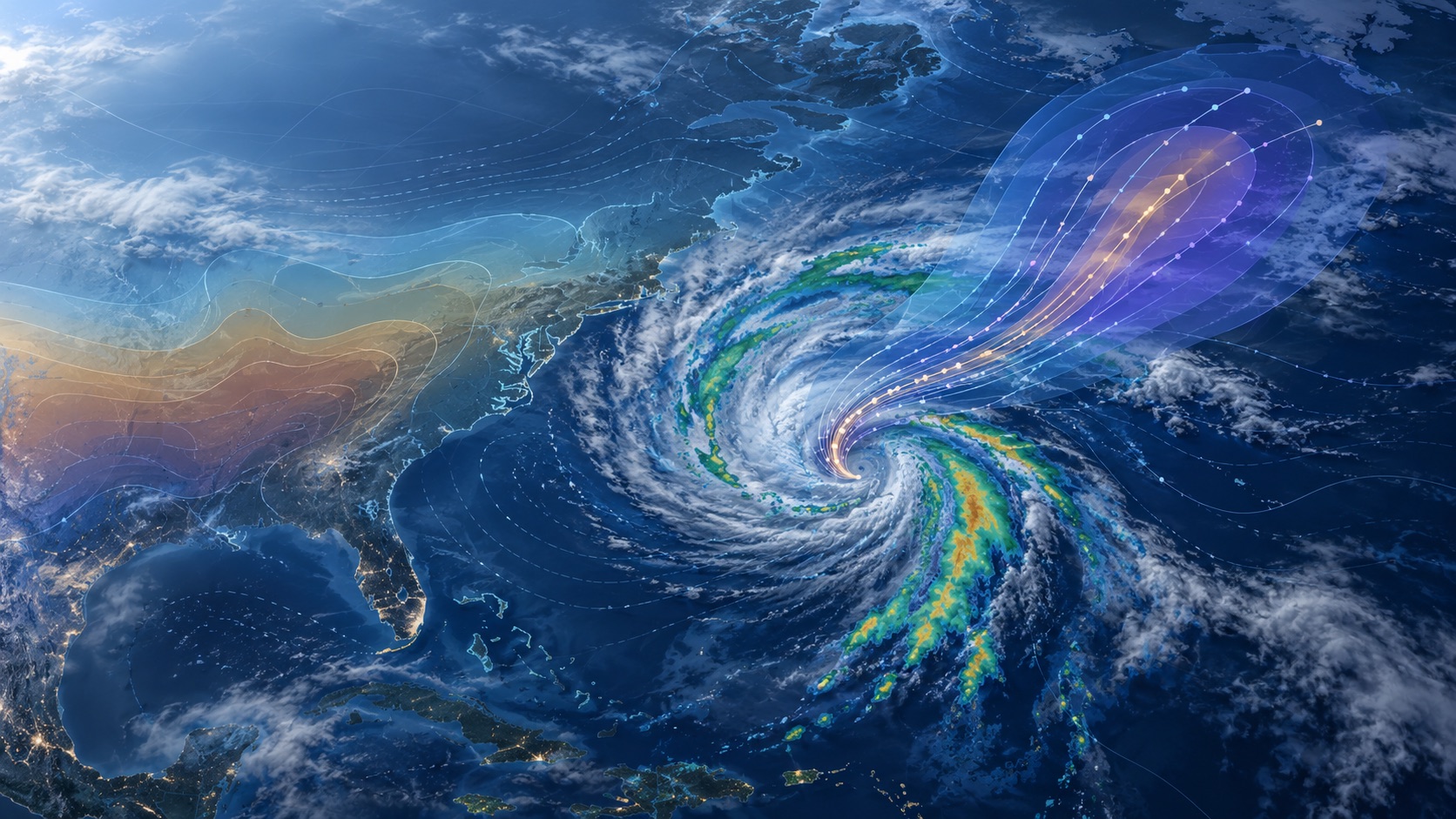
At 08:31:59 UTC on October 14, 2026, Microsoft Research publicly released research documentation and code for the Probabilistic Bias Correction (PBC) framework aimed at improving two-to-six-week subseasonal weather forecasts. The Verge’s authorized public feed also listed the development within the past 24 hours. PBC is not a new model replacing existing weather forecasting systems but rather a post-processing method: it reads forecasts from existing systems and corrects their systematic biases that are repeatable over time.
The Forecast Gap Beyond Ten Days
According to Microsoft, traditional physical models and newer AI models perform well within about ten days, but as forecasts extend into the two-to-six-week window, error accumulation and complex interactions between global Earth systems and local weather conditions begin to undermine reliability. Applications such as agricultural planting and fertilization, wildfire management, water and energy scheduling, and extreme weather preparedness require longer lead times; these are use cases for subseasonal forecasting, not quantified benefits already achieved by PBC. Public materials also do not claim that every day, region, or variable within the two-to-six-week period can achieve consistent performance levels.
PBC first examines historical forecasts from a base model to learn where it tends to err, then transforms the original deterministic ensemble forecast into a corrected probability distribution while preserving useful signals from the original model. The public repository notes that this framework accepts outputs from dynamical models, AI models, or hybrid systems. It adjusts only the probabilistic forecast results and does not alter the structure of all underlying models or eliminate inherent uncertainties in weather systems. Microsoft Research senior principal researcher Lester Mackey summarized the process as first learning error patterns and then producing corrected subseasonal outputs.
Correction Mechanism and Open-Source Paper
The related paper, titled "Advancing subseasonal forecasting with machine learning," was published in Nature with DOI 10.1038/s41586-026-11126-x. The research team has made the PBC code and citation metadata available on GitHub under an MIT license. The paper lists 13 authors, and the public repository provides examples of generating forecasts at different lead times. This release did not bypass Nature’s login or institutional access requirements; therefore, only publicly available information from Microsoft and the open-source repository was used, without including unverified full-text content.
Microsoft states that PBC improved 98% of precipitation targets, 92% of temperature targets, and 91% of pressure targets in the ECMWF’s operational bias correction subseasonal model; these percentages refer to the proportion of targets that were improved, not increases in accuracy by those percentages. Microsoft also claims that PBC doubled the accuracy of the ECMWF AI Forecasting System. All figures cited are from Microsoft's overview of the research findings. The public page does not provide full calculation details in one place and lacks independent third-party audit conclusions for replication.
Competition Metrics and Storm Cases
ECMWF launched the AI Weather Quest real-time competition in August 2025. A team composed of Microsoft and external collaborators, known as MicroEnsemble, applied PBC to ECMWF dynamical models and PoET hybrid models to form a system named MicroDuet. Microsoft claims that MicroDuet ranked first in every weather variable and lead time during the first three-month season ahead of the systems entered by 34 teams and six major operational forecasting centers; these are competition metrics.
Microsoft also states that MicroDuet maintained the highest accuracy throughout a full year of real-time forecasting and anticipated two winter storms that hit the United States 19 to 26 days in advance in early 2026. Public statements include visual case studies such as North American blizzards, cold snaps, and Winter Storm Fern, but do not guarantee that all storms can be captured with similar lead times. Individual lead times, competition results, and specific variable evaluations should not be used interchangeably; the public material does not provide a count of all failed cases.
Kenya Pilot and Product Boundaries
In East Africa, the Kenya Meteorological Agency is collaborating with Rhiza Research, the University of California, Santa Barbara’s Climate Hazards Center, and researchers from Karlsruhe Institute of Technology to test and pilot PBC. Current practice involves identifying probabilities of extreme or minimal rainfall to inform weekly updates for weather agencies; local forecasters continue to interpret and publish results. Kenya Meteorological Service Authority principal meteorologist Phillip Okello noted that the next step is to improve the accuracy of forecasts for heavy rainfall and drought periods. Microsoft has not disclosed any increases in agricultural yield or avoided disaster losses resulting from this work.
Microsoft states that its Microsoft Weather subseasonal-to-seasonal (S2S) model can provide weekly probabilistic guidance up to six weeks ahead, and is already running in real-time, but is currently only offered to selected customers in private preview. Public materials do not specify when or if PBC will be fully integrated into Windows, Bing, Copilot, Edge, or MSN; no details were provided regarding training and operational costs, commercial pricing, full deployment scope, customer lists, or independent third-party audits. At this stage, confirmed elements include the research, open-source code, competition performance, and limited pilot use—not a formal service for all users.